What Is Play Therapy? 3 Ways It Supports Kids’ Emotional Growth

Play therapy is a type of mental health care that helps children process difficult emotions and learn skills for healthy socializing and communication. It’s based on the idea that while children don’t yet have the language to talk about complex feelings, play comes more naturally to them—and may feel like a safer way for them to express.

Play therapy is evidence-based, meaning research supports its effectiveness in helping children of all ages heal from trauma and work through behavioral challenges. It can be very worth exploring for parents or caregivers who are looking for options to support their little ones through a difficult time.

Let’s look at how this engaging, creative therapy works and the benefits it could have for your little ones. 
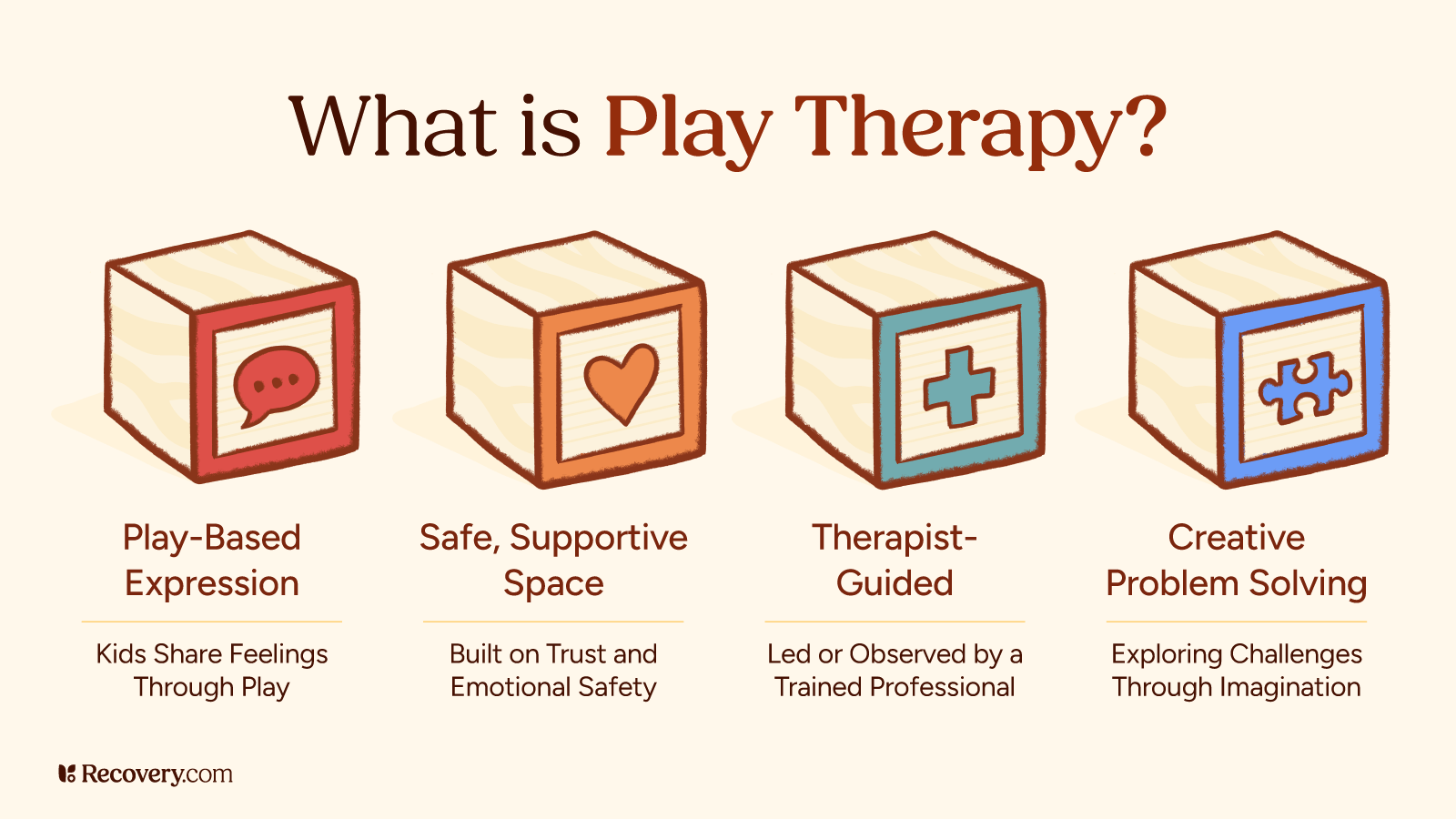
What is play therapy infographic with four building blocks representing key elements: play-based expression where kids share feelings through play, safe supportive space built on trust and emotional safety, therapist-guided sessions led by trained professionals, and creative problem solving for exploring challenges through imagination.

The Basics of Play Therapy: A Child-Centered Approach

Child-centered play therapy is a therapeutic approach that’s designed to help children ages 3–12 work through emotional and behavioral challenges using toys, games, and creative activities. It’s designed to meet children where they are and allow them to communicate what’s going on internally in a way that feels more comfortable and accessible to them.  

Play therapy expert and founder of the founder and director of the Center for Play Therapy Garry L. Landreth, Ed.D., LPC, RPT-S explains why kids can’t just do adult-style psychotherapy1

Children must be approached and understood from a developmental perspective. They are not miniature adults. Their world is one of concrete realities, and their experiences often are communicated through play. In seeking to facilitate children’s expression and exploration of their emotional world, therapists must turn loose of their world of reality and verbal expression and move into the conceptual-expressive world of children. Unlike adults, whose natural medium of communication is verbalization, the natural medium of communication for children is play and activity.

Play therapy sessions are safe, supportive settings for children to explore their feelings without judgment. It’s based on a relationship in which a registered play therapist uses special techniques to understand what children are saying through their play. This approach respects that children process experiences differently than adults and don’t have the vocabulary to describe complex feelings.

Tools Used in Play Therapy

Therapists choose the toys and materials used in play therapy carefully to encourage expression and exploration. These might include: 

  • Dolls and action figures for storytelling
  • Art supplies for creative expression
  • Legos or sand trays for building scenes
  • Games that promote social skills

Each item serves a therapeutic purpose, with the goal being to help children work through specific issues or develop certain skills.
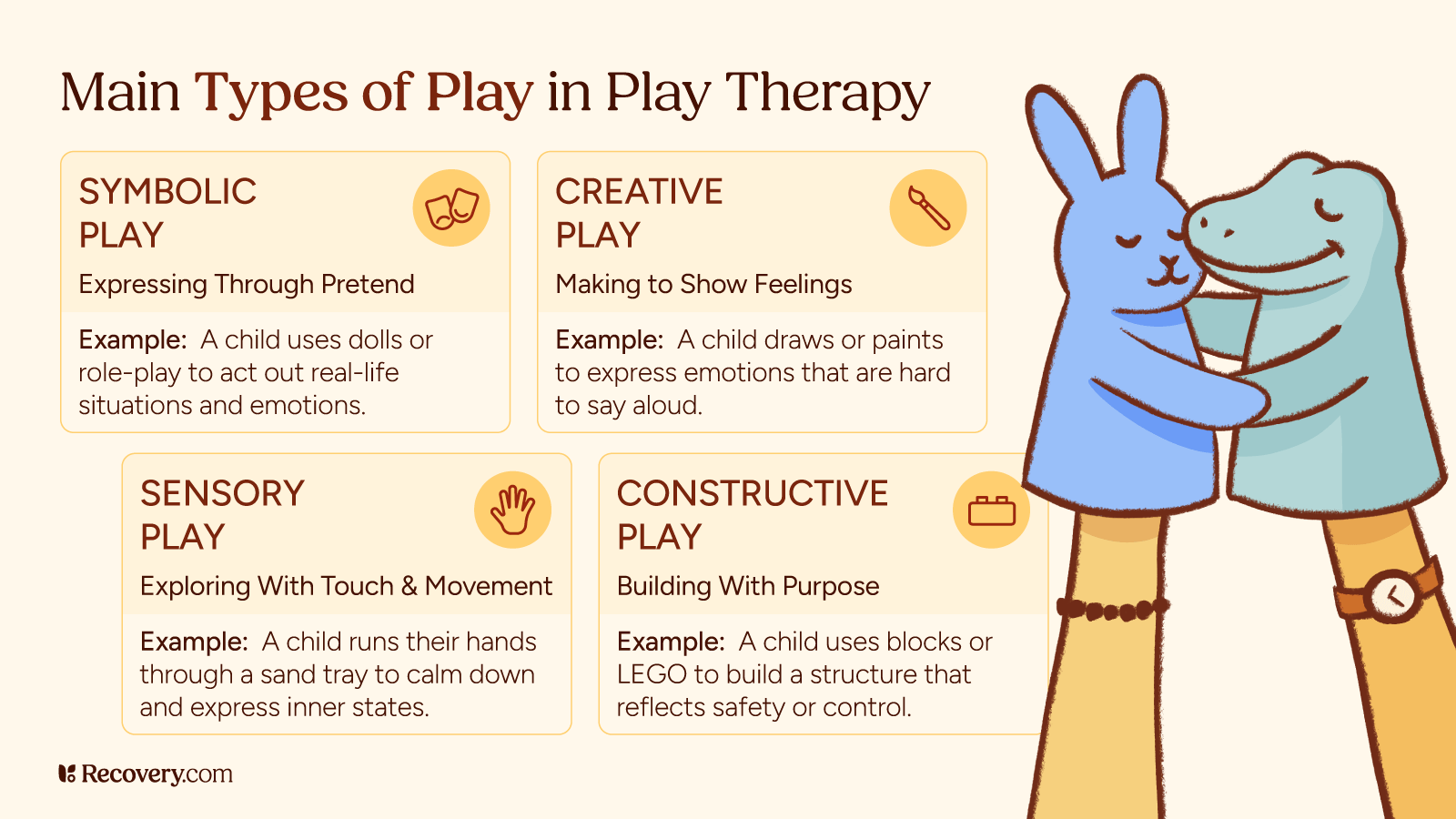
Infographic showing the main types of play in play therapy: symbolic play for expressing through pretend, creative play for making to show feelings, sensory play for exploring with touch and movement, and constructive play for building with purpose. Illustration shows two cartoon characters hugging.

A Research-Backed Experiential Treatment

This therapy is proven effective for treating a range of childhood mental health conditions. Studies show that play therapy helps children develop better emotional regulation,2 social skills, and coping strategies. It works because it honors children’s developmental needs, all in the context of professional guidance to support their healing and growth.

How Play Therapy is Different From Regular Play

Play therapy differs from regular play in a few ways. While all play can be beneficial for children’s development,3 therapeutic play is more intentional. It’s led by specialized practitioners who structure sessions to meet specific goals and use in-depth knowledge to facilitate the process. Because they’re educated in child development and mental health, they’re trained to recognize what children are trying to express and identify themes that emerge from these sessions. 

A good play therapist should plan sessions so they steer your child toward progress over time. 

Play Therapy’s 3 Main Goals

Play therapy serves 3 key functions that support your child’s mental health and emotional development:

1. Communication

This is the foundation of the effectiveness of play therapy. Most young children lack the vocabulary or emotional maturity to articulate complex emotions like grief, anger, or confusion—especially if they have conflicting feelings.4 A lot of little ones find it easier and more natural to express these emotions through play. They might use puppets to act out a conflict they witnessed at home, for example, or use sand play to build structures that represent their inner emotional landscape. This kind of communication bypasses the limitations of verbal expression and gives mental health practitioners a window into what children are really experiencing.

2. Emotional Processing 

Children often carry difficult experiences in their bodies and minds without fully understanding (or integrating) what happened to them. Play is a safe container for working through traumatic experiences5 at their own pace. For example, a child who experienced medical trauma might repeatedly give shots to stuffed animals, allowing them to eventually gain mastery over a scary experience. This kind of play helps children process emotions, reduce anxiety, and develop a sense of control over their experience.
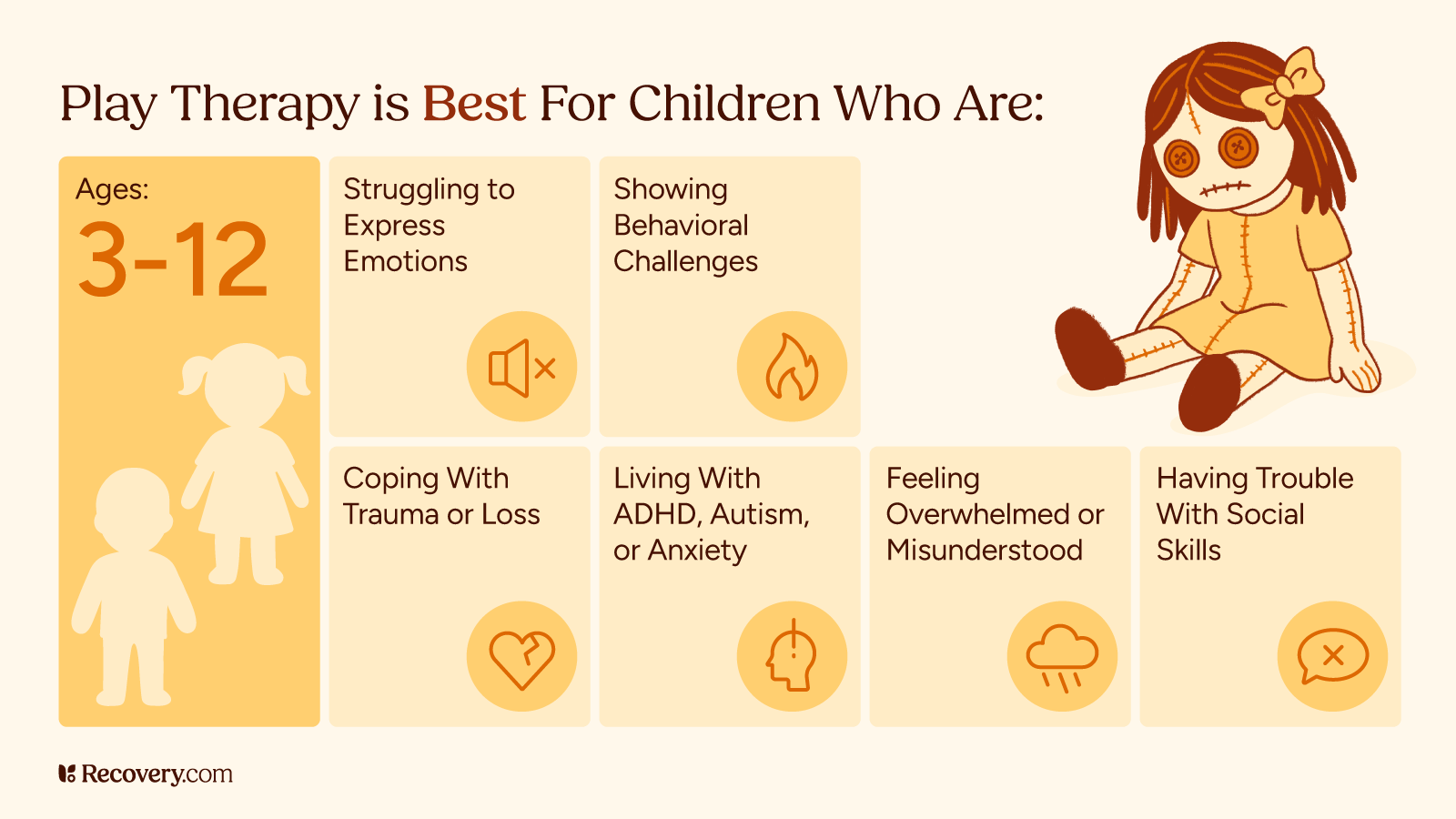
Play therapy is best for children who are infographic showing ages 3 to 12 with cartoon figures, plus categories including struggling to express emotions, showing behavioral challenges, coping with trauma or loss, living with ADHD autism or anxiety, feeling overwhelmed or misunderstood, and having trouble with social skills. Features illustration of child with doll.

3. Skill Building

This aspect of play therapy focuses on developing healthy coping strategies and social abilities. Through guided play experiences, children learn emotional regulation techniques, problem-solving skills, and healthy ways of relating to others. They might practice conflict resolution through role-playing games,6 develop patience through structured activities, or build self-confidence by mastering new challenges in a supportive environment.

Types of Play Therapy

Play therapy encompasses 2 primary approaches that therapists use depending on the child’s needs, personality, and therapeutic goals:

Directive Play Therapy 

In directive (or focused) play therapy,7 the therapist actively guides the session. They choose specific toys, games, or exercises designed to address particular issues or teach certain skills. For example, a they might use a specific art activity to help a child express feelings about their parents’ divorce, or use a game designed to build social skills for someone who struggles with peer relationships. 

This form of therapy works well for children who benefit from clear structure, have specific behavioral goals, or need direct skill instruction.

Non-Directive Play Therapy 

The non-directive approach8 follows the child’s natural lead, allowing them to choose activities and direct the session’s flow. The therapist holds a safe space, but lets the child decide how to use different play materials. This approach is based on trust that children naturally gravitate toward what they need to heal and process. 

A lot of experienced play therapists blend elements from both approaches based on what each child needs. 

What Age Groups Benefit From Play Therapy?

Play therapy is most commonly used for children between the ages of 3 and 12, though the approach can be adapted for younger and older kids depending on their needs. This age range is the time when children naturally tend to explore the world, process experiences, and express emotions through the use of play.

Preschool Children (Ages 3–5)

Play therapy works well for this age group because they have limited verbal skills but rich imaginations. At this stage, children process experiences through symbolic representation9 and repetitive play. A 4-year-old might not be able to explain feeling scared about starting school, but they can show these feelings by having toy animals hide or by repeatedly building and knocking down structures.

School-Age Children (Ages 6–12) 

Children in this age can still benefit from play therapy, though sessions might involve more verbal processing alongside play activities. These children can engage in more complex games, understand rules better, and begin to make connections between play and real life.10 They might like board games that teach problem-solving skills or art projects that help them express complicated family situations.

Teens and Adolescents

While play therapy is less commonly used with teenagers, some adolescents respond well to modified approaches that incorporate creative activities like music, art, or drama.11 The main factors are the individual child’s developmental level, interests, and comfort with play-based expression—not just chronological age.

Issues Play Therapy Can Address

Play therapy is effective for treating a wide range of conditions12 in children. The most common include:

  • Trauma and PTSD from abuse, domestic violence, accidents, or medical procedures
  • Anxiety and depression that cause withdrawal, sleep problems, or persistent worry
  • Behavioral problems including aggression, defiance, and difficulty following rules
  • Family transitions like divorce, the death of a loved one, or major moves
  • Attention-deficit hyperactivity disorder (ADHD), autism spectrum disorders that benefit from flexible, sensory-rich approaches
  • Learning disabilities that affect academic performance and self-esteem
  • Difficulties with social skills and problems with peer relationships
  • Grief and loss following deaths or significant life changes 

This more relaxed approach to therapy creates a safe space where children can process difficult experiences at their own pace.

The Benefits of Play Therapy for Children

1. It Develops Emotion Regulation 

Children who participate in play therapy often experience improvements in their well-being that extend far beyond the therapy room. Many develop stronger emotional regulation skills13 like learning to recognize when they feel overwhelmed and using healthy ways to calm themselves down.

2. It Addresses Social Anxiety and Improves Communication Skills 

Play therapy can also decrease social anxiety14 and improve communication skills. Better communication strengthens parent-child relationships and helps kids advocate for themselves in school and social situations.

3. It Builds Confidence and Self-Worth

Most importantly, play therapy helps children rebuild their confidence15 and self-worth. As they work through challenges in a supportive environment, many discover inner strengths they didn’t know they had. This growing self-assurance often translates into improved academic performance, stronger friendships, and more willingness to try new things.

Because play therapy is designed to be child-centered and flexible, your therapist can adapt it to meet your child’s needs. 

What to Expect in Play Therapy Sessions

Play therapy sessions usually last 45–50 minutes and occur weekly, though frequency may vary based on your family’s schedule. The therapist will create a consistent, safe environment filled with carefully selected toys and materials designed to encourage expression and exploration.

Parent involvement varies depending on the child’s age and treatment goals. Some therapists include parents in some sessions, while others work individually with children and meet with parents separately to discuss progress and strategies for home. It all depends on your therapist’s approach and your child’s needs.

Progress in play therapy often happens gradually,16 depending on your child’s natural pace. Your therapist should communicate regularly about your child’s development and adjust treatment approaches as needed.

How to Find a Play Therapist

When searching for a play therapist, look for licensed mental health professionals who have specialized play therapy training. This includes licensed therapists, social workers, and school counselors who have completed additional play therapy certification. Many therapists hold credentials from organizations like the Association for Play Therapy, which requires specific education and supervised experience in this field.

Ask potential therapists about their experience working with children who have similar challenges to your child’s situation. Learn about their therapeutic approach, session structure, and how they involve parents in the treatment process. Most qualified play therapists will offer an initial consultation to discuss your child’s needs and determine if play therapy is an appropriate fit.

Insurance coverage for play therapy varies, so contact your insurance provider to understand your benefits. Many therapists offer sliding scale fees or payment plans to make treatment more accessible. Recovery.com can help you locate qualified play therapists in your area who meet your needs and preferences.


FAQs

Q: How long does play therapy take to work? 

A: The total length of the treatment episode varies based on your child’s progress, but most children start to show some improvement within 6–8 sessions. Some children benefit from short-term intervention; others require longer-term support.

Q: Is play therapy covered by insurance? 

A: Many insurance plans cover play therapy if it’s provided by a licensed mental health professional. Check with your insurance provider for more information about your coverage. The team at your treatment center may also be able to talk to your provider and help you sort out insurance details. 

Q: Can parents observe sessions? 

A: Therapist policies on parent observation vary. Some allow occasional observation, while others believe children express themselves more freely without parents present. Discuss this preference with your chosen therapist.

Q: What if my child doesn’t want to play? 

A: Skilled play therapists can work with reluctant children by starting with less threatening activities and gradually building comfort. Children should never be forced to participate in activities that make them uncomfortable.

What Do Drugs Smell Like? 7 Substances You Can Detect by Their Odor

You’ve caught a whiff of something strange in your home, on your loved one’s clothes, or maybe in their car. When unfamiliar odors have you worried and trying to figure out if someone you care about is using substances, it’s natural to wonder, “What do drugs smell like?”

It’s a scary place to be. Maybe it’s your teenager coming home with an odd smell, your partner acting differently, or a family member whose behavior has you concerned. 

Many drugs do have distinctive smells that can help you identify what’s going on. Here’s how to know what different drugs smell like, what other signs to watch for, and most importantly, what to do if your suspicions are confirmed so you can handle this difficult situation with care.

Why Do Drugs Smell?

Drugs develop certain odors for several reasons. Some substances naturally have strong chemical smells because of their composition or the ingredients used to make them. Others pick up odors from how they’re manufactured, stored, or consumed.

The strongest smells normally come from drugs that are smoked, as burning or heating any substance tends to create odors that linger. You might catch these smells on clothes, in bedrooms, cars, or even on the person themselves.

Sometimes the smell comes directly from the drug, and other times it’s from whatever tools or materials they used to ingest it. Drug manufacturing often involves harsh chemicals too, which is often largely responsible for how street drugs smell.

What Do Different Drugs Smell Like?

1. Marijuana

Marijuana has one of the most recognizable drug smells—often described as skunky, earthy, or piney. Different strains can smell quite different from each other, ranging from citrusy to very pungent.

The smell is strongest when marijuana is smoked or heated, and it can linger on clothes and in rooms for hours or days. Research shows that over 200 compounds contribute to marijuana’s complex smell,2 which changes based on freshness and storage time. Marijuana stored longer tends to have stronger, more noticeable odors than freshly packaged marijuana.

2. Crack Cocaine

When someone smokes crack, it creates a distinct smell that people compare to burnt plastic or melting rubber. It’s a strong chemical odor2 that sticks around on clothes and in whatever space it was used in.

This smell is especially noticeable in small, enclosed spaces like bedrooms, bathrooms, or cars. Regular powder cocaine usually doesn’t have much of a smell.

3. Methamphetamine (Meth)

Meth has a strong chemical smell that people describe as ammonia-like, similar to cat urine, or like burning plastic. The smell can be especially strong around meth labs3 because the manufacturing process uses harsh chemicals like acetone, battery acid, and drain cleaner. Meth production also often uses sulfuric acid which can smell like rotten eggs.

If someone uses meth regularly, their sweat can start to smell like those chemicals. You might notice this on their breath or clothes, even when they’re not actively using.

4. PCP (Phencyclidine), a.k.a. Angel Dust

PCP is a strong hallucinogen that doesn’t smell like much of anything by itself. But when people smoke it, usually by sprinkling it on marijuana or tobacco, the smoke has a strong ammonia smell4 kind of like industrial cleaning products. The fumes are harsh and might make your eyes water.

5. Heroin

Pure heroin usually doesn’t smell like much. But street heroin often has additives that can make it smell like vinegar. When someone heats heroin to inject it, it might smell sweet and tar-like.

Black tar heroin has a more noticeable vinegary or acidic smell.5 When heated, it can smell like roofing tar.

6. Fentanyl

Fentanyl usually doesn’t smell like anything at all, which makes it especially dangerous—not just because people often can’t tell when it’s mixed with other drugs, but also because even a tiny amount can be deadly. This powerful opioid is often cut into other substances without people knowing, which means it’s easy for people to take it accidentally when they think they’re using something else.

Learn more about why this drug is so deadly—and how to recognize signs of use before it’s too late—in our article on the dangers of fentanyl.

7. Synthetic Marijuana (K2, Spice, Etc.)

Synthetic cannabinoids can be tricky because they’re designed to look and sometimes even smell like regular cannabis. But the chemicals used to make them can give off strange odors—some batches smell like mothballs, while others don’t have any scent at all. Because these drugs are made by spraying chemicals onto dried plant material,6 the smell can be inconsistent or artificial. And when there’s no odor at all, it can be harder to tell what you’re actually using—which adds to the risk.

Masking Smells

Some people try to cover up the smell of drugs with air fresheners, incense, or strong cologne or perfume. So if someone suddenly starts relying on heavy scents to mask odors, it could be a sign that something’s going on behind the scenes.

What About Drug Paraphernalia?

You might not always smell the drugs themselves—but you could notice personal items that carry a strong, unusual scent. Knowing what to watch for can help you connect the dots.

Tools used for smoking:

  • Glass, metal, or wooden pipes (often with burn marks or residue)
  • Homemade pipes made from carved apples, aluminum cans with holes, or plastic bottles
  • Rolling papers, blunt wraps, or torn pieces of paper
  • Multiple lighters or small torches
  • Mirrors, razor blades, or plates with white residue
  • Modified vape pens

Items used for injection:

  • Small plastic bags with corners cut off
  • Spoons with burn marks on the bottom
  • Syringes or needles
  • Cotton balls or Q-tips with stains
  • Rubber tubing, belts, or shoelaces used as tourniquets

Things like clothing, towels, or bags often take on the scent of whatever substance was used. If something seems out of place, stashed away, or suddenly smells off—especially alongside changes in behavior—it’s worth paying attention to.

Think You Smell Something? Here’s What to Do Next

If you’re noticing a smell that might be related to drug use, try not to panic or jump to conclusions. Take a step back, and give yourself a moment to gather more information first. It can help to ask yourself:

  • Where exactly is the smell coming from?
  • When do you notice it most?
  • Are there other signs or changes happening at the same time?
  • How is the person acting overall?
  • Could there be a non-drug explanation for what you’re smelling?

When something feels off, it’s natural to want to know more. But try to hold off on confronting someone in the moment, especially if they might be under the influence. Instead, wait for a calmer time when you can have a more productive conversation.

Other Signs to Pay Attention To (Beyond Just Smell)

Smell can be a clue, but it’s just one piece of the puzzle. Changes in behavior, appearance, and relationships often tell you more than scent alone. If you’re noticing a combination of signs, it may be time to look a little closer.

Behavioral Changes

  • Big shifts in personality or mood
  • Being secretive about where they go or who they’re with
  • Getting defensive over small questions
  • Losing interest in hobbies or things they used to care about
  • Trouble at work or school
  • Unusual sleep patterns or eating habits

Physical Signs

  • Red or bloodshot eyes, or pupils that seem unusually large or small
  • Frequent nosebleeds or a constantly runny nose (without being sick)
  • Poor hygiene or changes in grooming
  • Unexplained injuries, bruises, or marks
  • Shaky hands, slurred speech, or other changes in coordination
  • A persistent cough or raspy voice

Social and Financial Signs

  • Hanging out with a new crowd they won’t talk about
  • Missing money or valuables
  • Financial struggles or suddenly asking for money
  • Pulling away from close friends or family
  • Legal trouble or risky decisions

No single sign means something is definitely wrong. But when several of these things are happening at once, it’s worth paying attention. You know your loved one. If something feels off, it’s okay to trust your instincts.

How to Talk to Your Loved One About Drug Use

Confronting a loved one about their drug abuse is challenging, but necessary. How you approach it matters: A thoughtful, compassionate conversation can open the door to real change.

Before You Talk

  • Pick a time when you’re both calm and they’re not under the influence
  • Think about what you want to say, focusing on specific behaviors you’ve noticed
  • Be ready to listen more than you talk
  • Have some ideas ready for how you can help

During the Conversation

  • Use “I” statements like “I’ve noticed…” instead of “You always…”
  • Don’t use labels or give ultimatums
  • Tell them you love them and you’re worried about their health
  • Ask questions and actively listen to their answers
  • Be prepared for denial or anger—that’s normal

After the Conversation

  • Follow through on anything you promised
  • Keep showing love and support, but don’t enable their drug addiction
  • Take care of your own mental health too
  • Consider support groups for families dealing with addiction

One conversation probably won’t fix everything. Recovery usually takes time, professional help, and patience from everyone who cares about the person.

Get more tips on how to approach your loved one in our conversation guide.

Getting Professional Help

If someone you care about is struggling with substance abuse, professional help is available: 

A qualified addiction healthcare specialist can work with your loved one to create a personalized treatment plan based on a thorough assessment of their health history, behavioral health, and social factors. The most effective addiction treatment program for them will depend on their individual needs and circumstances.

Moving Forward With Support

If someone you care about is using drugs, you can provide support by keeping communication open, creating a supportive environment, setting clear boundaries, and helping them connect with the right professional help. 

Drug rehab admissions staff are usually happy to perform a brief, over-the-phone assessment, explain your options, and help you find the right care. Use our treatment finder to search for a recovery center today.


FAQs

Q: Can you smell if someone is doing drugs? 

A: Sometimes, yes. Certain drugs like marijuana, crack cocaine, and meth have distinctive smells that can linger in closed spaces, one someone’s clothes, or even in their sweat. However, some drugs like fentanyl and powder cocaine are largely odorless, making detection by smell impossible.

Q: What drugs have a strong smell? 

A: Marijuana, crack cocaine, and methamphetamine typically have the strongest, most recognizable smells. Marijuana smells skunky and earthy, crack smells like burnt plastic, PCP smells like industrial cleaning products, and meth has an ammonia-like chemical odor.

Q: Why does meth smell? 

A: Meth has a strong chemical smell because of the harsh chemicals used to make it, including ammonia and other industrial substances. When smoked, these chemicals create a distinctive odor that many compare to ammonia or burning plastic.

Q: What does heroin smell and look like? 

A: Pure heroin often has little smell, but street heroin may have a vinegar-like odor due to additives. When heated, it can smell sweet and tar-like. Heroin is often sold as a white or brown powder. Black tar heroin is dark brown or black and sticky.

Q: Can you smell fentanyl? 

A: No, fentanyl is generally odorless, which makes it particularly dangerous. People often can’t detect its presence by smell, even when it’s mixed with other drugs.

Q: What does crack cocaine smell like when smoked? 

A: Crack cocaine smells like burnt plastic when smoked. This chemical odor is unique and quite strong, often lingering on clothes and in spaces where it’s been used.

Q: How can you identify drugs by their smell? 

A: While some drugs have characteristic odors, smell alone isn’t reliable for identification. Marijuana can smell piney, citrusy, or like a skunk; crack smells like burnt plastic; heroin smells like vinegar; and meth smells like ammonia. However, many factors can affect these different smells, and some drugs are odorless.

Q: What does marijuana smell like compared to other drugs? 

A: Marijuana has a distinctive “skunky,” earthy smell that’s quite different from other drugs. Unlike the chemical smells of meth or crack, marijuana has more natural, plant-like odors with sour or citrusy notes.

Q: What are the common odors associated with illegal drugs? 

A: Common drug odors include: skunky/earthy (marijuana), burnt plastic (crack cocaine), ammonia/chemicals (meth and PCP), vinegar (some heroin), and mothballs (some synthetic drugs). Many drugs, however, have little to no smell.

The Signs of Drug Use in Teens

Drug use in teens is an increasing problem in the U.S. It’s important to recognize the signs of drug use in order to intervene and help teens struggling with addiction. Common signs of drug use in teens include changes in behavior, including mood swings, attitudes, and school performance. Additionally, physical signs can include red eyes, changes in sleep patterns, and changes in physical appearance. Finally, teens with drug addiction may show signs of financial or legal trouble, including stealing money or getting into trouble with the law.

If your child is using drugs, this recovery journey you’re about to embark on can not only help your teen, but it can also make your whole family grow closer. Getting teen treatment can set your child on the path to success. 

Signs, Symptoms, and Behaviors of Drug Use in Teens

If you know what to look for, you can discover if your teen is using drugs or drinking alcohol. Be on the lookout for these signs:

Changes in mood:

  • Irritable
  • Withdrawn
  • Unable to focus
  • Depressed or hyperactive

Changes in appearance:

  • Unkempt appearance
  • Bloodshot eyes
  • Flushed cheeks

Changes in behavior:

  • Sneaking out
  • Secretive about their phone or their whereabouts
  • Missing school or work
  • Hanging out with a new crowd of friends

How to Spot Drug Use in Teens

If you have a hunch your kid is using drugs, but you want to be sure, there are some things you can do to get a better idea of the situation:

  • Have eye contact conversations, and see if their eyes are bloodshot.
  • Smell for smoke.
  • Pay attention to their emotional state, this may be out of the norm.
  • Go through their belongings: This can be a sensitive topic. Giving your children the privacy they deserve is important, but if you are concerned about your teen’s safety and well being due to possible drug use, you may want to consider this option.

Teen Drug Use Statistics

 According to the National Institute on Drug Use, since the start of COVID-19, reported drug use has decreased1. This is likely due to school closure and social distancing (i.e. less peer pressure). Luckily, the downward trend has continued through the last couple of years; however, substance use still poses a threat.

The Most Commonly Used Drugs Amongst Teens

The most commonly used drugs reported in 2022 were nicotine/vaping, cannabis/marijuana, and alcohol. (Keep in mind that these are only the reported statistics. More teens likely use these substances and just don’t report it.)

  • 20.5% of 10th graders vaped
  • 19.5% of 10th graders ingested cannabis
  • 15.2% – 31.3% of 10th graders drank alcohol

While this downward trend provides some hope, research findings show dramatic and rising death rates in youth between the ages of 14-18. 

Also, it’s important to know that fentanyl, amongst other dangerous players, has contaminated the U.S. and worldwide drug supply2. This substance is extremely potent, meaning even the tiniest drop can make the user overdose. Fentanyl could be found in drugs like cocaine, MDMA (ecstasy), and heroin because it’s cheaper to cut these drugs with fentanyl than sell the pure substance.

Educating yourself on these dangers, and knowing how to help your child, is crucial for prevention, awareness, and recovery if/when needed.

Reasons Why Teens Use Drugs

Each teen has their reasons for using drugs. Here are some common factors that can push them to experiment.

  1. Peer Pressure: Being a teenager is hard, and they just want to fit in with their peers. If their best friend, or someone they admire, offers them drugs or alcohol, they’ll likely take it to feel accepted. 
  2. Media: TV shows, movies, and especially social media nowadays can show drug use as glamorous, normal, or fun. This can appeal to impressionable teens.
  3. Self-Medication: Mental health issues start to pop up around adolescence, and some teens may see the escape of drugs as a way to avoid these complex feelings.
  4. Experimentation: Teens are curious and ready to try new things, especially as they start to gain some freedom.
  5. To Feel Grown Up: Wanting to be a grownup and assert their independence can lead them to drinking or doing drugs.

Find Help for Teen Drug Use

So you’ve had the conversation with your teen about their drug or alcohol use. Now is the time to start gathering resources on how to help them.

  1. Gather Information: Begin by browsing programs for teens. Think through what you want to get out of this experience—for your child and your family. You may want to look for gender-specific care. These programs address hardships that boys and girls uniquely experience by giving them tools to face uncomfortable emotions and experiences. Gender-specific care also helps them focus on treatment without distractions. 
  1. Engage in Family Therapy: Family therapy will likely be an important part of the recovery process, for your teen and your whole family. Addiction education for loved ones is usually offered with this, as well. This gives clarity on your teen’s journey with substances and recovery. So when your child comes home after treatment, everyone will have the skills they need to maintain a healthy recovery environment.
  1. Be Supportive: Most importantly, be a rock for your child. They’re likely going through a confusing time, so having your support will make this process easier and improve their chances of success.
  1. Make Sure You Have Support: Give yourself grace through this journey. Helping your child through addiction recovery can be emotionally draining. You will have support from medical professionals, but other family members or friends can also provide support in this process. 

4A. Remember to prioritize your own self-care. Engage in activities that bring you joy and practice stress-reducing techniques.
As your kids grow older and start making their own decisions, you can act as a compassionate guide and lead by example. What you do from here on out is what matters most. A bright future awaits for your child with the right teen treatment.

find help for teen drug use

Affordable Luxury Care in the Tropics: 7 Reasons to Consider Rehab in Malaysia

Lush surroundings, cost-effective treatment, and quality care: these are just a few of the advantages of luxury rehabs in Malaysia

Treatment facilities here can help you heal from the inside out. And with plenty of interesting activities, holistic treatments, and personalized programs available, Malaysia is the perfect backdrop for many people’s recovery journeys. We’ll explore those reasons in depth below.

1. Malaysia’s Dense Rainforests and Dreamy Coastlines are Healing Settings

In the tropical climate of Malaysia, vibrant rainforests teem with life. Bright vegetation encircles the capital city, Kuala Lumpur. Hot weather combines with plentiful rain to make greenery flourish. Green gives way to blue once you reach the sandy beaches that ring the country’s coastlines.

If this is the setting you’d like to start your recovery journey in, you’re in luck: several luxury rehabs offer comprehensive care in Malaysia. One such facility is Shine Wave Retreat, in the hills of Johor Bahru. Palm trees pepper the outdoor patio and grassy knolls surround the campus. Patients find refuge at this private oasis while they seek recovery for mental health conditions like anger, depression, or bipolar disorder.

Unique Jungle and Ocean Activities 

Some rehabs in Malaysia plan outings that immerse clients into the stunning landscape. Solace Asia, for example, has a variety of exhilarating outdoor activities to choose from. Time here might include white water rafting on local rivers, spotting monkeys, birds, and lizards on local trails in the forest, or reef diving among tropical fish and sea turtles.

Whatever adventure you embark upon, you won’t just be having fun—you’ll also be healing. Research shows that challenging yourself with new activities is beneficial for mental health.1 Adventurous pursuits make you feel good because they activate the same areas of the brain that rewards do. Learning new things strengthens your brain by creating new pathways. You’ll build confidence by accomplishing things that scare you. And you’ll feel more fulfilled—“a sense of flourishing,” says Frank Farley, Ph.D., a professor at Temple University.

And thanks to the tropical climate, it’s possible to do many of these activities most days of the year.

2. The Year-Round Warm Climate 

You can expect temperatures in Malaysia2 to range from warm (23°C or 73°F) to hot (32°C or 90°F). Because Malaysia has a tropical clim​​ate,3 conditions will be both humid and rainy. Monsoons bring heavy rainfall. The northeast monsoon lasts from November to March, and the southwest monsoon occurs from May to October.

If you’re wondering what to pack for rehab, definitely bring clothes for hot weather. However, most people in Malaysia are Muslim and dress conservatively. Because of this, it’s more acceptable to wear loose, lightweight clothing with more coverage for outings. A staff member at your facility can help you decide what to bring.

3. Malaysia Rehabs Accommodate Your Needs

It’s important to have your needs met as you focus on the challenging work of recovery. Whether you have diet restrictions or co-occurring mental health conditions, luxury treatment facilities in Malaysia are happy to accommodate.

Special Programs for Adolescents and Young Adults

No one is exempt from mental health conditions. Children, teens, and adults can all face challenges like depression or anxiety. In fact, research shows that mental health issues are on the rise in kids.4 And many struggle with additional distress due to recent world events. A report from the World Health Organization (WHO) found a 25% increase in anxiety and depression5 of people worldwide in 2020. 

Fortunately, centers like Shine Wave Retreat and The Wave Youth Clinic offer specialized treatment for young people, so no one is left behind.

The Wave Youth Clinic in Kuala Lumpur is a dedicated teen and young adult treatment center. Their full spectrum of care includes boarding and education, outpatient, and online services.

The Wave Youth clinic
An indoor pool, yoga deck, and outdoor basketball court are some of the amenities available at The Wave Youth Clinic in Kuala Lumpur, Malaysia.

Flexible Dietary Offerings

Good nutrition is crucial in recovery as you heal from the damage of substances and stress. Whether you’re gluten-free, dairy-free, plant-based, or adhering to religious guidelines, treatment centers cater to clients’ dietary needs.

At Serene Retreat, staff can prepare Kosher, Halal, vegan, or vegetarian meals. At Solace Asia, all food served follows Halal guidelines. Many luxury rehabs place a focus on healthy eating and will gladly adjust their menus to your dietary restrictions—check with admissions staff for details. 

Dual Diagnosis Treatment

Mental health conditions often underlie substance use disorders. This is known as a “co-occurring disorder” or “dual diagnosis,” and many people aren’t aware of this until they discover it in treatment. It’s more common than you may think: about 9.2 million adults in the U.S. have a co-occurring disorder.6

Co-occurring disorders are complex, and require treatment by a team that truly understands them. You might require a combination of techniques that involve clinical, holistic, and medication-assisted care. Solace Asia is one rehab that specializes in dual diagnosis treatment.  Clinicians work with clients to create a personalized treatment plan that’s based on psychotherapy and may or may not include medication, depending on your needs. 

solace sabah slide 0
Solace Asia‘s quiet, tropical property sits tucked away in the heart of Kuala Lumpur, Malaysia.

4. Healing (and Happiness) With Holistic Care

Luxury rehabs in Malaysia emphasize holistic care. Holistic treatment focuses on the whole person, addressing physical, mental, spiritual, and social needs as part of the recovery journey. Mind-body practices like yoga and mindfulness meditation facilitate the healing process and reconnect you to your happiness.

“Many of us forget to be happy,” says Solace Asia’s CEO & Clinical Director Dr. Prem Kumar Shanmugam. “Happiness is the basis of living. And I think whatever we do, it has to be based on being happy.”

Yoga

Yoga combines breath and movement to calm the mind and rebalance the body. Its many health benefits include reducing stress, depression, and anxiety.7 Avoiding difficult emotions is a huge driver of addictive behavior. But yoga helps people come into an easier, less judgmental relationship with these feelings—thus decreasing the urge to use.

It’s no surprise, then, that yoga is a common fixture at many rehabs. And this holds true at treatment centers in Malaysia, like Shine Wave Retreat, where clients are encouraged to take part in regular classes.

Art Therapy

You don’t have to be a skilled artist to try art therapy; the goal of this experiential therapy is to serve as an outlet for your personal expression. Art therapy provides a safe environment to process feelings that are difficult to discuss. 

According to research, art therapy supports the recovery journey8 in these ways:

  • boosts self-esteem
  • improves self-awareness
  • builds emotional resilience
  • develops social skills
  • increases insight
  • reduces stress

The Wave Youth Clinic uses art therapy to help their teen and young adult clients through a variety of challenges. “Art therapy offers our young people a safe form of emotional expression and communication, unrestricted by language and/or communication difficulties,” says the center’s Clinical Lead, Mahisha Naidu. “The art offers a bridge between their inner world and the outside world, free of the confines of meeting certain levels of cognitive functioning.”

5. Cost-Effective Recovery

Rehabs in Malaysia are extremely affordable compared to other countries. At Serene Retreat, clients pay MYR 25,000 (about $5,500 USD or £4,500 GBP) for 28 days. 

Rehabs in the West have a much higher cost—private rehabs in the U.S., for example, average $1,000 USD per day or more. Treatment in Malaysia means all-inclusive care at an accessible price point. 

serene retreat sabah dining
Serene Retreat in Kuala Lumpur, Malaysia offers luxury accommodation at an accessible price point.

CEO & Clinical Director of Solace Asia, Dr. Prem Kumar Shanmugam says increasing access to mental health treatment is part of Solace Asia’s mission:

“When we first started Solace, our mission was to make sure anyone suffering from addiction could recover and live a normal life. After a few years, we revisited our mission and realized we have to make treatment affordable to the masses.”

And budget-friendly options don’t mean you have to sacrifice comfort. Luxury rehabs here are well-appointed with amenities like gourmet dining, outdoor pools, fitness facilities, adventure outings, and more.

6. Ambitious Treatment Standards

Many rehabs in Malaysia strive to stay up to date on the latest research and treatments. Dr. Shanmugam explains how the team at Solace Asia works to continually improve their programming

“We have a team of addiction treatment experts who are certified in this field specifically,” says Shanmugam.

“We make sure that our clinical team goes for training continuously. We are involved in research, in publications. We constantly keep ourselves updated with the latest treatment approaches.”

The Wave Youth Clinic also strives for clinical excellence, aiming to “raise the bar in the standards of family and adolescent therapy” internationally. Their integrated treatment approach is based on 7 core elements: clinical, medical, education, global citizenship, outside-inside, experiences, and destination future. 

7. Easy Air Travel

Malaysia has 6 international and 16 domestic airports.9 You’ll most likely fly into the Kuala Lumpur International Airport (KLIA), as this is the main international airport. Once you arrive in Malaysia, it’s easy to take a connecting flight to an airport closer to your final destination. Most luxury rehabs can help you arrange airport transfers, and some can even connect you with sober coaches or companions to accompany you on the journey to the facility. 

See more on arranging treatment abroad in our article on traveling to rehab

Find Peace in the Land Below the Wind

Malaysian rehabs can be a great option for those who want treatment in a luxury setting, at non-luxury prices. The country’s incredible jungle and beach destinations and relaxed pace of life can go a long way toward easing the transition into recovery. 

See our list of luxury treatment centers in Malaysia to learn more about facilities, pricing, and program highlights, and reach out to admissions staff directly.

Could Sunny Malibu Be the Perfect Place for Your Recovery?

If you love the sun, beautiful beaches, and holistic healing in a laid-back atmosphere, then attending a rehabilitation facility in Malibu could be a great choice for you. Malibu is known for its year-round warm weather and beautiful scenery, as it’s located between the Pacific Ocean and the Santa Monica Mountains. It’s hard to believe that Los Angeles is only a 30-minute drive away.

Many Malibu treatment centers take advantage of their location and temperate climate, offering programs like surf therapy in addition to outdoor excursions like beach walks or hikes. Holistic therapy is also a popular method of treatment throughout California, and several centers in Malibu embrace this approach.

You may want to start your journey to mental health and addiction recovery in Malibu if you enjoy ocean views, a warmer climate, and unique therapy techniques focused on the outdoors and alternative medicine.

Malibu’s Inviting Climate and Landscapes

Malibu is in close proximity to nature, with stunning views in every direction. Malibu’s 11 public beaches are located along 21 miles of coastline on the famous Pacific Coast Highway, and include some of the best beaches in California, including Zuma Beach and El Matador State Beach.

Several recovery centers, such as Oceanside Malibu, are located right on the coast. You’ll be able to hear the sounds of the waves from Malibu Beach as you work on healing, take long walks by the water, or participate in beach fitness activities.

Mountains rise up behind the city, providing an abundance of hiking opportunities with beautiful views. Malibu has plenty of parks, including the Santa Monica Mountains National Recreation Area, which has over 5,000 miles of hiking trails on 156,000 acres of land. Solstice Canyon Park and Malibu Creek State Park are 2 other popular outdoor recreation areas that people enjoy exploring.

Some centers, like Cliffside Malibu, are located in the mountains themselves. This scenic landscape offers plenty of space for peaceful reflection. You can either explore the trails nearby or relax on the sun deck to take in the stunning views of the Pacific Ocean.

Malibu’s Mediterranean climate means you can comfortably enjoy outdoor activities like swimming, hiking, and biking in any month of the year.

Unique, Recovery-Focused Activities

Many centers offer activities that are best experienced in the California sunshine. Between the ocean and the mountains, there are endless opportunities to explore the outdoors. And because California is such a multicultural hub, some centers offer opportunities to visit nearby museums and attractions.

Surf Therapy

Several rehabs, including Oceanside Malibu and Cliffside Malibu, offer surf therapy for their clients. Surf therapy is a healing modality1 that “combines surf instruction, surfing, and structured individual and/or group activities to promote physical, psychosocial, and psychological well-being.” One study found that surfing improved overall well-being for combat veterans with post-traumatic stress disorder (PTSD),2 and offered both a respite from the symptoms of this condition, and increased positive feelings gained from connecting with peers.

cliffside malibu slide 8
Perched in the mountains of Santa Monica, Cliffside Malibu offers therapies ranging from reiki to surf therapy.

Surf therapy is also a promising method of treatment for adolescents. Research shows that surf therapy has a positive impact on mental health,3 improving emotion regulation, social competencies, and social connections, while decreasing behavioral problems and depressive symptoms in youth experiencing psychological difficulties. Another study found surf therapy improved adolescents’ self-confidence4 through the feelings of accomplishment that come from mastering a new skill, a sense of escape, and strengthened social connections. Paradigm Teen & Young Adults Treatment understands the positive effects that surf therapy can have, and offers this activity to its adolescent and young adult clients.

Other Outdoor Activities and Experiential Therapies

Because Malibu is so close to the beach, many centers invite their residents to go on beach walks, or engage in related activities like swimming and hiking. The region’s warm weather gives clients plenty of opportunities to relax in the fresh air throughout every season. Milestones Ranch even holds therapy sessions while walking on the beach.

According to research, exercise can help clients navigate addiction recovery,5 and participating in new activities can build confidence through the mastery of a new skill. Oceanside Malibu encourages clients to participate in surf therapy, rock climbing, horseback riding, fishing, and other adventure outings. These exciting experiences can help clients find new hobbies and improve the mind-body connection, all while working through difficult emotions that may not easily come up during talk therapy.

Events and Cultural Outings

Milestones Ranch offers exposure therapy activities both on and off their 160-acre private property. This center’s take on exposure therapy, which they term “supervised sober recreation,”6 lets clients participate in activities while sober that they may have only previously done with drugs or alcohol. Clients can attend musical performances and dance parties at the ranch, in addition to weekly outings at comedy clubs, museums, concerts, movie theaters, and more off the property. According to this treatment team, participating in exposure therapy helps “build the client up through social and sober activities, providing the practical skills and confidence needed to socialize without the use of drugs.”

After some time in treatment, Milestones Ranch even gives clients opportunities to plan outings themselves with other friends from nearby sober living houses. This can help clients get accustomed to being in social settings while sober.

Specialized Treatment for Teens and Young Adults

Building community is important in recovery, as studies show that people with more close friends are more likely to recover from addiction.7 And oftentimes, people may find it easier to make friends with peers that they can relate to. Because of this, it may be beneficial for adolescents and young adults to attend teen-specific treatment centers surrounded by others of their own age.

According to Visions Adolescent Treatment, “Adolescents need to be approached differently than adults because they are still developing their emotional and environmental understanding.” With this in mind, the center only treats adolescents between the ages of 13-18. They provide daily activities and hold events at their rural rehab center, set in the Malibu hills to minimize distractions and keep the focus on recovery.

visions adolescent treatment slide 4
Visions Adolescent Treatment is tucked away on 25 acres of tranquil grounds in Malibu.

“When I came to Visions, I was extremely depressed and emotionally volatile. I was anxiety-ridden and I really didn’t see the point in life,” says JuliAnn Crommelin, a Visions Adolescent Treatment alum. “Visions not only got me sober, but they gave me the life that I never knew I always wanted.”

“It’s About a Non-Judgmental, Supportive Environment”

Paradigm Teens & Young Adults Treatment caters to clients aged 12-26, although teens and young adults are treated separately. Paradigm Treatment conducted a study that followed up with 195 of their clients a year after completing treatment and found that their depression, anxiety, and stress levels significantly decreased during rehab,8 compared to reported levels at their intake.

Paradigm focuses on creating a community-based environment that fosters healing and space for reflection. Dustin Wagner, Paradigm’s COO, explains:

“We know right off the bat it’s about building a relationship. It’s about a non-judgmental, supportive environment…Where other clients are also supporting each other. This program is transforming lives and providing hope to these families.”

Both Beachside Teen Treatment Center and Pacific Teen Treatment also focus exclusively on treatment for teens and their families. Pacific Teen Treatment even offers academic activities so that teens don’t fall behind in school during their recovery process.

As their parent, you may need to make treatment decisions for your teen. As JuliAnn from Visions Adolescent Treatment says,

“I’m grateful that my mom knew what to do with me, because at that point in my life I didn’t know what I needed, and looking back on it, I needed a parent who knew to call the professionals.”

Malibu’s Top-Notch Care

Malibu’s treatment facilities are highly regarded nationwide. Cliffside Malibu and Seasons in Malibu rank among the best rehab centers in California,9 according to Newsweek. The survey reviewed addiction recovery programs throughout the U.S. based on their quality of service and overall reputation.

Some centers focus on smaller group sizes in order to offer more personalized treatment. For example, Oceanside Malibu only accepts 6 people at a time. This allows them to offer each client a highly individualized experience. They also focus on building community within this small number of clients.

Director Dave Johnson describes Oceanside Malibu’s welcoming atmosphere:

“When people come to Oceanside, we try to create a family-like environment where people are allowed to heal and feel safe enough, and in doing that we try and break down that shame and guilt and get rid of it because it doesn’t serve any purpose.”

A Holistic Approach to Healing From Addiction

Mindfulness is a powerful way to approach recovery.10 According to experts at UC Berkeley’s Greater Good Magazine, mindfulness is defined as “maintaining a moment-by-moment awareness of our thoughts, feelings, bodily sensations, and surrounding environment, through a gentle, nurturing lens.” This practice encourages you to focus on the present moment, which helps alleviate anxiety about past painful or stressful situations and potential future ones. Studies have shown that meditation can aid in addiction recovery11 by decreasing cravings and improving control over one’s emotions.

Many centers incorporate mindfulness practices into their treatment programs, taking a holistic approach to treatment. Summit Malibu, for example, blends Eastern and Western mindfulness practices to help clients with the physical, mental, and spiritual symptoms of addiction. Clients can participate in yoga, art therapy, meditation, relaxation therapy, somatic experiencing, and more. William Oswald, the center’s CEO and Founder, says:

“To treat substance abuse and mental disorders12 we must go deeper than the physical being. As a recovering addict, I know that healing comes from within. That’s our mission at Summit Malibu.”

Avalon Malibu incorporates experiential therapies like traditional Chinese medicine (TCM), herbs, and neurofeedback into their programs, along with mindful practices like meditation, yoga, and qi gong. TCM includes natural products and acupuncture, which are especially helpful in treating opiate addiction. Acupuncture may help alleviate withdrawal symptoms13 and possibly even help clients avoid a relapse. This modality can also improve the immune system, have a positive effect on memory, and decrease the likelihood of neurological disorders.

Cliffside Malibu offers many different forms of holistic therapies and treatments, like Reiki, acupuncture, hypnotherapy, and more. These practices can help bring clients peace and promote healing, especially when combined with Malibu’s beautiful natural setting.

Ease of Travel to Malibu

Malibu is easily reachable by plane, and is just a short drive from Los Angeles International Airport (LAX), one of the largest airports in California and busiest in the U.S. It’s hard to believe that this coastal haven is so close to such a busy metro area, but that certainly makes travel much more convenient.

Since Malibu is located right along Highway 1, which has some of the best views in California, it’s also easily accessible by car.

Peaceful Addiction and Mental Health Recovery on the Coast

It’s up to you to determine the best place to start recovery. Traveling to Malibu for rehab might make sense if you’d like a more peaceful, quiet setting surrounded by mountains and beaches, and would like to try beachside experiential therapies.

Malibu’s tranquil surroundings may offer you clarity and a sense of calm, so you can focus all your energy on healing. However, this setting may be too quiet for some clients. Even with Los Angeles so nearby, treatment in Malibu may not be a good fit if you feel more comfortable in a big city.

See our collection of rehabs in Malibu for an inside glimpse into treatment, including virtual tours, pricing, and reviews.


Frequently Asked Questions About Malibu Rehabs

What rehab programs are available in Malibu?

Malibu treatment centers take advantage of their ideal location and climate, offering activities like surf therapy, beach walks, and hikes. Holistic therapy is popular in California, and several centers in Malibu embrace this approach.

Why go to rehab in Malibu?

You may want to start your journey to mental health and addiction recovery in Malibu if you enjoy ocean views, a warmer climate, and unique therapies focused on nature and alternative medicine.

What city in California has the best rehab?

Malibu’s treatment facilities are highly regarded nationwide. Cliffside Malibu and Seasons in Malibu rank among the best rehab centers in California, according to Newsweek (based on quality of service and overall reputation).

Houston Rehabs: Specialized Care by Top-Notch Professionals

Houston—or “H-Town” as it’s often called by locals—is known for its year-round warm and sunny weather, numerous outdoor activities, and multicultural population. Many treatment centers in Houston take advantage of the temperate climate, outdoor programs, plentiful walking paths, gardens, and more.

Houston offers exceptional treatment options for executives, youth and adolescents, and LGBTQ+ clients, and is in close proximity to the Texas Medical Center (TMC), the largest medical complex in the world.1

By choosing a comfortable setting for recovery, you can relax and focus on your healing process. Houston could be the best place for you if you’re looking for easy access to nature, laid-back local culture, and a diverse area with some of the best medical professionals in the industry.

Houston’s Outdoor Opportunities

This vibrant city is full of outdoor areas for residents to enjoy. In fact, Houston was ranked number 1 in the United States for total green space2 compared to other cities of similar density. The area is often warm and sunny, although it’s considered “subtropical” and still gets about 50 inches of rain per year on average. Buffalo Bayou runs through the city, and the surrounding park offers a beautiful backdrop of lush greenery against its skyscrapers.

Spending time outdoors and in nature helps promote healing and relaxation. One study found that just 5-10 minutes of exercise outside each day improves both mood and self-esteem.3 Houston offers many opportunities for residents to experience nature, whether by kayaking through Buffalo Bayou, running on the oak-lined path along the Outer Loop at Rice University, or hiking through tropical forests at Big Thicket Park.

Houston’s Diversity

Houston is full of rich cultural diversity. It’s known as a multicultural city and hosts one of the largest Pride parades in the U.S.,4 with almost 700,000 in attendance in 2019. It’s the 4th largest city in the country, and Houston’s current demographics show the projected outlook for diversity5 in the rest of the nation in 40 years. Thanks to this diversity, health professionals in Houston are well-equipped to treat a wide variety of conditions, adapting their care to specific patients.

The Texas Medical Center

Texas medical center
The Texas Medical Center is the world’s largest medical city, spanning over 2 square miles.

The Texas Medical Center is a world-renowned medical district,6 taking up more than 2 square miles in south-central Houston. The center includes 21 hospitals, many of which are considered the best in the U.S., as well as 8 academic and research institutions. Together, these facilities make up the 50+ total medical organizations in the region. Houston’s close proximity to TMC means that health professionals in this area are often some of the best in their fields, and up to date on the latest research to better help you with your recovery.

Connect With Your Community in Houston Rehabs

Rehab is an opportunity to build community with people who share similar goals. If you enjoy spending time outside, desire a more multicultural setting, or are interested in the arts, a program in Houston might be a good fit. LGBTQ+ rehab clients will feel especially welcome here, as will people of multicultural backgrounds. By connecting with people who share some of your life experiences, you can give and receive mutual support during recovery.

Recovery for Adolescents and Young Adults

J. Flowers Health Institute and The Menninger Clinic both provide care for adolescents and young adults. Both institutes place a heavy focus on one-on-one counseling and offer family therapy. They work to create extremely personalized treatment plans for younger clients, within environments that have been designed to meet their unique needs. “That’s the piece that means the most to me, is really seeing people go home, and thrive in life,” says the center’s founder, Dr. James S. Flowers.

menninger clinic
The Menninger Clinic has been treating clients for over 95 years and offers programs specialized for certain demographics.

Gender-Specific and LGBTQ+ Treatment

Several treatment centers understand the importance of gender-specific recovery. Eudaimonia Recovery Homes, for example, has a women’s home, a men’s apartment, and an LGBTQ+ house. These affordable residences are meant to provide safe and secure living environments, and are accompanied by a 3-phase recovery program that helps to “promote personal growth and life skills, provide accountability, and support ongoing sobriety with outpatient services.” Sometimes, being surrounded by people with similar life experiences can help you feel more comfortable throughout the healing process.

Eudaimonia Recovery home living room
Eudaimonia Recovery Homes provides gender-specific recovery and housing.

Programs for Executives

The J. Flowers Health Institute specializes in treating professionals and aims to provide quality care in a shorter amount of time. “We have the brightest minds in the country here in Houston, Texas because of the Texas Medical Center,” says co-founder Robbin Mooney. “What normally takes weeks or months to get in front of some of the top specialists here, Dr. Flowers and the team can usually get our clients in 1-2 days.”

J.Flowers yoga
J. Flowers Health Institute sits on spacious, verdant grounds and offers access to top-notch professional care.

Traveling to Houston

Houston is easily reachable by plane. Its 2 airports are serviced from many destinations, both domestic and international. Driving is also an option, although flying is certainly easier. A staff member from your rehab center will typically pick you up upon arrival at the airport. Make sure you check with your admissions team before booking your travel plans, to find out which options are available.

Houston is a bustling metropolitan area, but many treatment centers are tucked away in quieter suburbs or across larger grounds for a more peaceful setting. The city is also easily accessible by car.

Amenities and Activities

Houston locals enjoy spending time outdoors and getting involved in the city’s arts and music scene. Some treatment centers even invite clients to focus on artistic pursuits during treatment. For example, both The Right Step and Briarwood Detox offer music and art therapies. These, along with other experiential therapies “allow you to focus on the mind-body connection, an important aspect of healing.”

At Briarwood Detox, you’ll participate in art activities—like group drawing projects or meditating to music—3 times each week. Residents can also enjoy live music performances twice a month. According to the experts at this center, “music not only works to combat feelings of anxiety and depression, but it may also help clients associate music with sobriety instead of substance abuse.”

While in Houston, you can take advantage of the warm sunshine and enjoy various outdoor activities. The city is located near the Gulf of Mexico, and residents can soak up the sun on beaches within a short driving distance of the city. Many treatment centers also have outdoor spaces where residents can walk, jog, relax, and participate in mindful activities like yoga and meditation. These activities aren’t just enjoyable; they’re also an important part of recovery. Data show that hospital gardens help reduce stress,7 which boosts the immune system and helps promote faster healing.

luna recovery pool
Residents can soak up the sun out by the pool at Laguna Recovery.

In addition to these outdoor amenities, most Houston rehabs have air-conditioned rooms that keep residents comfortable in the heat. Some treatment centers, like Luna Recovery, hold adventure outings for residents. The Right Step also offers recreational therapy. During these weekly outings, you might play basketball at a park, see a movie at the theater, or visit a local museum.

Warmth and Welcome at Houston Recovery Centers

Spending time in a new space—and outside of your usual comfort zone—may offer you some much-needed clarity. If you decide that traveling for rehab is for you, it’s important to choose a location that suits your unique preferences.

Attending a treatment center in Houston would be a great choice if you love spending time outside in warmer climates and desire a more diverse and multicultural area. The easy access to top medical professionals at TMC will ensure that you have some of the best quality care possible. Rehabs in this area allow patients to stay connected with nature, art, and culture, while still taking the time they need to heal.

View our list of different treatment centers in sunny Houston.


Frequently Asked Questions About Rehab in Houston

What sets rehabs in Houston apart from others?

Houston rehabs stand out thanks to their medical care, quality service, upscale amenities, specialized programs, and Southern hospitality.

What therapies are offered at rehabs in Houston?

Rehabs in Houston offer a diverse range of evidence-based and complementary therapies. These may include cognitive-behavioral therapy (CBT), experiential therapy, mindfulness practices, and holistic treatments, all aimed at promoting personal growth and sustainable recovery.

Do rehabs in Houston offer aftercare support?

Yes, Houston rehabs understand the importance of ongoing support after completing a treatment program. They typically provide aftercare services like alumni programs, counseling sessions, and support networks to help individuals maintain sustainable recovery.

Nature, Adventure and Good Vibes at Hawaii Luxury Rehabs

Hawaii is the quintessential holiday destination—and for good reason. From the rainbow-hued reefs of Lana’i to the volcanic peaks of Mauna Kea and the verdant valleys in between, this Pacific wonderland has something for everyone. Luxury rehabs in Hawaii leverage the islands’ abundance of activities, and the power of its thriving nature, to offer a treatment experience in the true aloha spirit. Rehabs here tend to embody Hawaii’s island lifestyle:

  • A focus on adventure and activities
  • Immersion in nature
  • Embracing community and spirituality
  • Holistically and naturally creating life change

Getting Oriented

Hawaii is located smack dab in the middle of the Pacific. The archipelago comprises 19 volcanic islands, 4 of which are inhabited by residents and a steady stream of visitors. Each of these major islands has its own, distinct allure:

Hawaii (the Big Island)

Also known as “the Big Island,” Hawaii is by far the largest in the archipelago, accounting for 63% of its landmass. However, much of the island is rural, and it houses only 13% of the state’s population. The Big Island is home to active volcanoes, waterfalls, coffee, vanilla, macadamia nut farms, cattle ranches, and black, green, and white sand beaches. On the west coast, Kona offers historical landmarks, vast landscapes, and mellow swimming beaches. On the east coast, Hilo features a rocky coastline dotted with waterfalls, lava rock pools, rainforests, and towering volcanoes.

Most rehabs in Hawaii are located on the Big Island.

Oahu

Hawaii’s best-known and most developed island, Oahu is home to Honolulu, the most populous city in the state. Waikiki Beach is most popular with tourists, while the island’s famous North Shore draws surfers from around the world in the swell season.

Maui

Separated into east and west by a valley running down its center, the west side of Maui hosts beachfront resort areas like Kaanapali. Hana, on the undeveloped east side of the island, is full of stunning nature reserves accessed by the Hana Highway, which takes visitors past wonders like the Seven Sacred Pools.

Kauai

Known as the “Garden Isle,” Kauai’s heavy rains mean it boasts some of the greenest rainforests in the state. Natural wonders here include the Wailua River, Waimea Canyon, and the rugged Nā Pali Coast.

Activities

The Hawaiian Islands offer endless activities, including (but not limited to) the following:

  • Surfing
  • Diving
  • Snorkeling
  • Hiking and eco-tours
  • Horseback riding
  • Air tours
  • Whale watching (from December through April, and June through August)
  • Shark diving
  • Climbing volcanoes
  • Swimming with dolphins

While some programs offer these outings as a way to spend free time on weekends, others harness their therapeutic power via experiential therapies. For those who find healing through the power of the ocean, some Hawaiian rehabs even offer surf therapy.

Local Culture

Hawaii isn’t just about postcard-perfect beaches. It’s also home to a rich indigenous culture with its own language, music, dance, and foodways. Visitors to the islands can get a taste of these by joining in hula, ukulele, or lei-making lessons, or visiting museums showcasing the islands’ history and arts.

Healing With the Spirit of Aloha

In Hawaii, the spirit of aloha is palpable. In addition to being an innately enjoyable place to live, many people say they sense a special, uplifting, and calming energy that’s native to the land itself. Locals who call Hawaii home, and those who come for only a short time relish the chance to connect with the land. Rehabs here who foster this link to land and community do their best to respect Hawaiian traditions. Hawaii is ethnically diverse: it’s home to native Hawaiian, Chinese, Japanese, Korean, Thai, Portuguese, Samoan, Tahitian, Tongan, and Micronesian peoples, among many more.

Its distinctly laid-back vibe permeates every aspect of daily life, and the recovery process is no exception. This may be a good treatment location for you if you’re looking to shift out of a stressed-out mindset and reconnect with life’s essentials.

Weather

Hawaii offers year-round warm weather, with temperatures that rarely dip below 75°F (24°C). Those from colder climates especially enjoy Hawaii’s consistently summer-like atmosphere. And this doesn’t just make for a pleasant vacation, but can potentially have a real impact on your recovery.

Leo Sher of Columbia University’s Department of Psychiatry discusses the link between seasonal depression and alcoholism.1 “Seasonal changes in mood and behavior (seasonality) may be closely related to alcoholism. Some patients with alcoholism have a seasonal pattern to their alcohol misuse. They may be self-medicating an underlying seasonal affective disorder (SAD) with alcohol or manifesting a seasonal pattern to alcohol-induced depression.” Favorable weather, on the other hand, may also play a favorable role in your treatment outcomes.

Some months in Hawaii are hotter or rainier than others, but in general, you can expect good weather any time of year. The mildest temperatures are found during May and September. October and November are typically the hottest months, while January sees the most rain. Keep in mind that Hawaii has multiple microclimates,2 and temperatures and rainfall may vary according to your specific location. It’s also not uncommon for weather patterns to change several times during a given day.

Because the islands’ daily operations are heavily affected by tourism, airfare may vary depending on whether you arrive during high season (winter and summer) or low season (spring and fall). Prices may also peak at times of year coinciding with U.S. vacations, like spring break.

Who Is Rehab in Hawaii Best Suited For?

Rehab can be somewhat insular, as this contained experience provides space for you to turn inward and focus on the work of making major life changes. But it can also incorporate elements from the outside world, giving you a chance to experience your surroundings in a deeply healing way. It’s also a great opportunity to build a sober community with like-minded people. After all, your peers in treatment likely chose the same program you did because it spoke to similar interests. If this sounds like you, Hawaii might be a great place to begin your recovery journey:

  • You’re active or adventurous.
  • You rejuvenate by connecting with nature.
  • You prefer to learn through hands-on experiences.
  • You’re open to holistic approaches and trying new treatment methods.
  • You want to incorporate your spirituality into your healing process.

Facilities and Amenities

Hawaiian luxury treatment centers tend not to be overtly lavish, but offer plenty of comforts for a relaxing stay:

  • Simple yet comfortable accommodations
  • Ocean views
  • Natural surroundings
  • Walking and hiking trails
  • Pools and hot tubs

Most Hawaiian luxury rehabs also have beach access (but aren’t necessarily beachfront), and include visits to multiple nearby beaches as part of their regular outings.

Professionals and Expertise

Rehab teams are comprised of staff that coordinate and deliver core programming, as well as specialized treatment modalities:

  • Medical doctors and nurses, including addictions specialists
  • Board-certified psychiatrists
  • Clinical psychologists, including specialists such as family therapists and trauma specialists
  • Holistic professionals such as naturopaths, acupuncturists, licensed massage therapists, and yoga instructors
  • Youth-specialized counselors, field therapists, and guides
  • Recovery and life skills coaches

Connecting With Nature and Self: A Glimpse Into Hawaiian Rehab Programs

Below are some examples of programming you’ll find on the islands. While each program offers its own mix of clinical and complementary therapies and caters to different clientele, they all have one thing in common: encouraging a connection with Hawaii itself.

Hawaii Island Recovery: Community and Spirituality

hawaii island recovery
Hawaii Island Recovery and its beautiful surroundings.

Located on Hualalai Mountain on the Big Island, this Joint Commission-accredited residential adult treatment center admits a maximum of 8 clients at a time.

The center uses a holistic treatment approach, emphasizing community, spirituality, and connecting with nature through the many activities on offer. According to their team, “The surrounding landscape is incredible and we love to get out and find empowerment in the natural beauty of Hawaii… The change that comes from making a new life, one day at a time, is complemented by images of waterfalls, black sand beaches, and sacred Hawaiian monuments… Spiritual leaders are generous enough to join us, providing guidance from their backgrounds as we search to discover our own path.”

Therapies at Hawaii Island Recovery incorporate clinical care (individual and group therapy, EMDR, CBT, and DBT), holistic health (mindfulness-based stress reduction and yoga), and recreational activities. These include ocean-based therapy, swimming with wild dolphins, visits to local beaches, and experiential cultural programming to honor the island’s heritage.

The center’s home-like residence offers ocean views and chef-prepared meals, as well as access to a hot tub and fitness center with a personal trainer. Clients can choose from 30, 60, or 90-day programs.

Pacific Quest: Adolescents and Young Adults

Pacific Teen Treatment
Pacific Quest serves adolescents and young adults. They place a strong emphasis on clinical care combined with naturopathic approaches, like wilderness therapy.

Located in Hilo on the Big Island, this program serves young clientele and places a strong emphasis on wilderness therapy. Clients enroll in one of two programs: an adolescent program for ages 13-17, and a young adults program for ages 17-24. While these contain specialized courses specific to each age group, both programs focus on experiential learning and include horticultural therapy, which takes place in the center’s on-site gardens. Both programs also offer an accredited academic curriculum for those who haven’t completed high school.

Pacific Quest’s integrative psychiatry program combines clinical care with naturopathic approaches, and includes psychiatric and medication management services as needed. “Integrative psychiatry uses both conventional and complementary therapies to address individual treatment needs,” says the center’s clinical team. “Our psychiatrist, medical team, and primary therapist collaborate with the student and their family to develop personalized treatment plans to reduce symptoms and build self-efficacy strategies.” Therapies here include evidence-based psychotherapy, adventure therapy, art therapy, nutrition, somatic experiencing, and family involvement.

In addition to the campus’s gardens, natural surroundings, and ocean views, clients can access nearby waterfalls via trails on the property. Activities include beach walks and fitness, water activities, and yoga.

The ‘Ohana: Outpatient Care and Hawaii-Style Sober Living

the ohana
Oro House Recovery green, tranquil grounds help patients reconnect with nature.

The ‘Ohana, meaning “family” in Hawaiian, lies in the heart of Kailua-Kona on the Big Island. Here, clients attend an intensive outpatient program while living on-site in their sober living community. The center admits 6 to 15 clients at a time, and offers 30, 60, 90, and 120-day stays.

Programming here integrates evidence-based, holistic, and adventure therapy, and incorporates the local surrounds into clients’ treatment experience. “At the ‘Ohana, we believe that setting and environment play an important role in an individual’s healing,” says their team. “By removing triggers and taking the time to reconnect to nature in beautiful Hawaii, we optimize the individual’s ability to heal.” Therapies include DBT, CBT, psychodynamic therapy, meditation, nutrition, and ecopsychology. They also offer an executive program.

Clients at the ‘Ohana can choose from activities like touring volcanoes, hiking in cloud forests, zip-lining, snorkeling, swimming with dolphins, and horseback riding. The property is set on 5 acres of tropical land, and recovery residences feature private rooms, each with an ocean view and pool access.

Making the Most of Your Time on the Islands

Hawaii offers no shortage of sights to see, and luxury rehabs here often include excursions as a weekend activity. Depending on status upon discharge, clients may also choose to take advantage of their time on the island to soak up more of its healing beauty. This can also potentially be arranged with loved ones who visit as part of a family program. Notable destinations on the islands include the following:

Hawaii Volcanoes National Park (Big Island)

Hawaii Volcanoes National Park3 is home to Kilauea and Mauna Loa, 2 of the world’s most active volcanoes. Designated as an International Biosphere Reserve and UNESCO World Heritage Site, the park offers visitors a chance to see the active volcanoes in action via day or backcountry hiking.

Haleakala National Park (Maui)

Haleakala National Park4 is home to several endangered species that can only be seen in this unique habitat. The most popular activity here is hiking to its peak to catch the sunrise, which appears otherworldly in the above-the-clouds landscape.

NaPali Coast (Kauai)

The rugged coastlines of NaPali Coast State Wilderness Park5 are accessible only by foot or boat. Here, streams and waterfalls cut dramatic valleys into the cliffs as they make their way to the sea. Those seeking a more adventurous travel experience can hike or camp onsite (which may require special permits).

North Shore (Oahu)

Oahu’s North Shore6 is best known for attracting surfers from around the world to its celebrated breaks in the winter months. But it also offers thrills for non-surfers, like shark diving and hiking among the picturesque trails of its national parks.

Accessibility and Travel

Hawaii is the most remote populated island chain in the world.7 As such, air travel is by far the most common and easiest option to, and even between, the islands. Whether domestic or international, the vast majority of flights land in Honolulu. Depending on your city of origin, you may find a direct flight to your destination island, or you may connect from Honolulu via an interisland flight. Direct service from the mainland is also available to Kahului on Maui, Kona and Hilo on the Big Island, and Lihue on Kauai. Nonstop flights to Honolulu fly out of most major West Coast airports, as well as some in Asia-Pacific.

Once on the island, your rehab will provide transportation for any off-campus activities and can provide direct pick-up from the airport. Those who wish to visit multiple Hawaiian islands typically schedule 3, one-way flights (for example, if you choose to explore Hawaii further after treatment). Rehab admissions staff are usually happy to help with travel arrangements.

Finding Hope in the Rainbow Capital of the World

The grounding, elevating, good-for-the-soul environment that Hawaii offers can be one way to set yourself up for success as you embark on the challenging project of recovery. To learn more about treatment options in the state, visit our list of Hawaii luxury rehabs.


Frequently Asked Questions About Rehab in Hawaii

What makes rehab in Hawaii unique?

Rehabs in Hawaii stands out due to their picturesque surroundings, integration of Hawaiian culture and holistic approaches to recovery, and wide variety of recovery activities. Serene beaches, lush landscapes, and its peaceful environment adds to the unique experience.

What addiction treatment programs are available in Hawaii?

Hawaii provides a comprehensive range of addiction treatment programs, including detoxification programs, residential rehab, outpatient services, and holistic treatments. Rehab programs in Hawaii cater to diverse needs, and may be especially suited for people who want to connect back to nature.

What activities are offered in Hawaii rehabs?

Hawaii rehabs offer a variety of amenities and activities to support the recovery journey. Activities that make the most of Hawaii’s natural wonders include eco-tours, adventure outings, whale watching, and more. Centers here offer a host of other holistic treatments, from yoga to meditation classes and more.

Finding the Right Rehab for Your Teen or Young Adult

Anyone can struggle with substance use. Whatever your age, gender, job, or relationship status, you deserve to get the care you need. However, it can sometimes be hard to know what interventions would be most helpful. This is especially true for teens with substance use disorders.

Substance use during adolescence may have long-term effects on brain chemistry.1 For example, “cocaine exposure during adolescence may lead to miswiring in the developing brain and result in long-lasting behavioral problems, such as increased risk-taking, in adulthood.” Because of this, it’s especially important to get teens the help they need in order to begin recovery.

Young people may not always be able to recognize that they need help. And even when they do, they may not be legally or financially capable of seeking that help on their own. Whether you’re a teen or an adult caring for a teen with substance use disorder, the good news is that (specialized) treatment is widely available. Many rehabs offer programs created specifically for younger clients.

If you’re considering rehab for your teen, it’s important to understand the different options available. Depending on the client’s age and geographical location, there may be certain types of treatment that are more appropriate. This decision will also be influenced by your teen’s unique history, diagnoses, and treatment goals.

Reasons for Teen Substance Use

Research suggests that “the human brain is still maturing during the adolescent years.2 The developing brain may help explain why adolescents sometimes make decisions that are risky and can lead to safety or health concerns, including unique vulnerabilities to drug abuse.”

Beyond the simple fact of their age, there are many elements that impact a young person’s likelihood to misuse substances. Among them are risk factors, which make substance use more likely, and protective factors, which guard against these behaviors.

These external influences change with a person’s age. While that’s true for all clients, these changes occur more drastically in children, adolescents, and young adults. For example, middle school students who are too harshly disciplined are at greater risk for substance use disorders. Receiving support from extended family, on the other hand, makes substance abuse less likely in this population. Slightly older adolescents are at greater risk for substance misuse3 when they lack adult supervision, and at lower risk when family members set clear expectations.

Also, teens are experiencing heightened stress4 in this turbulent era of history. According to one study, even teens who had not experienced early life stress—such as neglect or abuse—were prone to “increases in anxiety and depression symptoms” during 2020. In this context, young people may be at a greater risk of developing mental health conditions than they once were.

It’s impossible to guard against every single circumstance that increases the risk of teen substance misuse. However, it can be helpful to familiarize yourself with some of the most prevalent risk factors. Whether or not you’re able to protect yourself or your teen from these stressors, knowing what they are may empower you to get help when it’s needed.

Parental Substance Use

If an adolescent is close to an adult who has a substance use disorder,5 they may be at a higher risk for developing one themselves. For some young people, this is simply a way of enacting the same behavior they’ve seen modeled. Others may use substances in order to cope with the stress of an unstable home life.

Strained familial relationships, financial insecurity, and similar issues can be hugely impactful. However, instability refers to more than these external circumstances. These teens may also have genetic predispositions to substance use disorders, as well as other mental health diagnoses.

Co-Occurring Disorders

Certain mental health concerns, such as depression and ADHD,6 make teens and young adults more likely to misuse substances. In some cases, this is an attempt to self-medicate. However, it’s not always that simple.

For teens with multiple diagnoses, the root cause of substance use can easily become a question of the chicken or the egg. As their brain chemistry continues to change, due to either normal development or unhealthy habits, they may begin to develop co-occurring disorders that make substance use even more appealing.

Whatever the cause of this behavior, few teens have the resources to pull out of this cycle without external interventions. In some cases, inpatient treatment is the most effective way to begin recovery.

Choosing a Rehab for a Young Adult

If you’re a parent or guardian supporting a struggling teenager, it can be difficult to know what’s best for them. And even if you’re confident that they should go to rehab, you may or may not be legally allowed to make that decision on their behalf

In some U.S. states, a parent can unilaterally decide to send a teen to rehab. In other areas, minors’ consent is also required. This varies widely based on the client’s exact age and geographical location. It’s best to learn what your family’s options are before making any specific plans regarding residential treatment.

The client’s age will also help determine which treatment program is best for them. For example, while it may seem that children and younger teens are more likely to grow out of a difficult phase, they may actually be in greater need of interventions. According to one study, “people are most likely to begin abusing drugs during adolescence,7 and the longer adolescents defer experimentation, the less likely they are to develop long-term drug abuse problems.”

Many rehabs often treat a wide variety of mental health concerns, not limited to substance use disorders. Teens and young adults may also benefit from rehab if they’re struggling with eating disorders, personality disorders, or even PTSD. Each of these diagnoses requires a slightly different approach to treatment, possibly including different levels of family involvement.

Some teens are able to live at home during treatment, receiving in-person support from family and friends while they begin recovery. Others may benefit from traveling to rehab. This gives clients both physical and emotional space from the challenges of daily life. It can also teach young people to set boundaries with those who enable their substance use. While this change of scenery may seem drastic, it has the potential to be extremely helpful. Remember that there is no one right way to heal; just the right way for each individual person.

Types of Teen Rehab Programs

If and when you’re ready to choose a rehab center, it’s best to learn as much as possible about the available options. Various programs specialize in treating different conditions, and each takes a unique approach to the process of healing. Because of this, it’s best to choose a facility that is qualified to meet your teen’s unique needs.

Substance Use and Eating Disorders

Eating disorders are extremely common among adolescents. As of 2018, as many as 10% of young women suffered from an eating disorder.8 What’s more, a growing body of research links eating disorders with addiction.9 One theory even suggests that anorexia nervosa is in fact “an addiction to the body’s endogenous opioids.” A number of rehabs focus on helping clients with one or both of these diagnoses.

Gender-Specific Treatment

For some clients, having space from people of different genders can feel like a much-needed break. This gender-specific approach to recovery may be especially helpful for adolescents. Studies show that young men and women exhibit “unique patterns of substance use,”10 and may therefore benefit from distinct approaches to treatment.

Some rehabs focus on treating young women. The program at Foothills at Red Oak Recovery, on the other hand, is tailored to meet the needs of young men, as well as non-binary and gender non-conforming teens. Although it is an LGBTQ+-affirming rehab, it is probably not the right fit for cis women.

Foothills at Red Oak
Foothills at Red Oak in Ellenboro, North Carolina has specialized programs for young men, non-binary and gender non-conforming teens.

In this protected environment, clients are invited to explore their developing identities. According to staff, “​​Adolescence is a time of self-discovery and identity formation…If one successfully navigates the tasks during this stage of life, one emerges with a solid sense of identity. This is a sense of knowing oneself despite the chaos and pressures of the world around them and is paramount to making healthy, value-based decisions.”

Experiential Therapy

Experiential therapy can be hugely beneficial for people of all ages. In this group of modalities, you may go skiing, river rafting, or rock climbing. Some rehabs even take their clients on adventure outings, where they might hike the lip of a volcano or swim with the dolphins.

These experiences aren’t just fun excursions; they’re also ways to practice the skills learned in talk therapy in a different context. They can also encourage clients to develop new hobbies, and help to restore the connection between mind and body. The latter is especially important for teens in recovery.

By surfing, horseback riding, or just playing sports, young people can get back in touch with their bodies and learn how it feels to be physically healthy. Experts theorize that this has a lasting impact on their continued sobriety and health. According to one study, “continued physical health for rehabilitated adolescent drug addicts is crucial…since it could enhance the effectiveness of rehabilitation.”11

With this in mind, some adolescent rehab programs have a special focus on physical activity. Pacific Quest, for example, is a wilderness therapy program located on Hawaii’s Big Island. Here, clients participate in outdoor programming which may include hiking, paddle boarding, swimming, sailing, and more. Participants also perform community service during their time in residence. Through this process, they are encouraged to learn how to engage with nature, their communities, and themselves in a healthy way.

Personalized Treatment

There are numerous ways to approach recovery. Although many teens benefit from highly structured rehab programs, others may require a more nuanced approach. For these clients, personalized treatment may be the best option.

Pacific Teen Treatment, for example, treats only six clients at a time. Each teen is assigned a primary, secondary, and family therapist. Their team of providers works together to carry out a highly individualized plan of care. This approach may not be appropriate for all clients—especially those who want to focus on improving their interpersonal dynamics within a larger cohort. But it can be extremely effective for families who are committed to healing their relationships with one another.

Family Therapy

Adolescent substance misuse impacts family dynamics.12 According to one group of experts, “every chemically dependent person has a significant impact on the lives of several other people.” Because of this, it’s important for the parents, siblings, and other relatives of these clients to engage in their own healing processes.

In many cases, family therapy is a productive way to approach this. Most adolescent rehab programs offer some version of family therapy. This may include in-person sessions, video chats, or regularly scheduled phone calls.

Pacific Teen Treatment
A peek inside the calming environment at Pacific Teen Treatment in Malibu, California, where family therapy is a key area of focus.

Some facilities may limit clients’ communication with people outside of their cohort. Often, these programs restrict cell phone use during rehab. Others may prohibit calls or visits at the beginning of the program, but encourage this type of contact after some time has passed. Every rehab has its own unique guidelines, and those guidelines may vary from one client to another.

Therapy isn’t easy. This process may bring up traumatic memories and shine a light on difficult family dynamics. Even so, it is often an essential component of helping a teen recover from substance misuse.

Growing Beyond Substance Use

Substance use disorders are serious conditions. At any age, and especially for teenagers, this behavior should not be dismissed as “just a phase.” That being said, it can be temporary. It’s always possible to heal and grow beyond unhealthy habits.

A person’s adolescent years are powerfully creative. Over time, teens will inevitably learn more about themselves, defining their identities and discovering their own needs, goals, and values. It’s extremely important to connect these clients with the help they need and deserve. It’s also important to trust the process.

To see reviews, virtually tour facilities, and more, see our curated list of adolescent rehab programs.


Frequently Asked Questions About Rehab Programs for Teens

Why are teen rehabs important for addressing substance abuse and mental health in adolescents?

Teen rehabs play a crucial role in providing specialized treatment for adolescents who face substance abuse and mental health issues. Through therapy, education, and support, these programs help teens and young adults overcome challenges and develop skills for long-term recovery.

What treatment approaches are used in teen rehabs?

Teen rehabs use a variety of treatment approaches:

evidence-based treatment, such as cognitive-behavioral therapy (CBT); 
• individual and group counseling; 
• experiential therapies, like adventure outings;
• family therapy; 
• and more.

These approaches aim to address the unique needs of teenagers and support their physical, emotional, and psychological well-being.

How long do teens typically stay in rehab?

The duration of teen rehab programs vary depending on the severity of the issue, individual needs, and treatment plans. Most programs range from 30 to 90 days, while others extend for longer. The focus is to provide comprehensive support and equip teens with the tools for sustainable recovery.

California Rehabs: What’s Available and What to Ask to Make Sure You Know What You’re Getting

landscape shot of houses, palm trees at sunset in San Clemente, CA

California is home to more than just breathtaking scenery, iconic beach culture and a world-famous entertainment industry—it also hosts some of the most innovative and effective rehab centers in the world. With its top-notch professionals, state-of-the-art technology, emerging holistic practices and year-round perfect weather, the Golden State is a coveted rehab location. But with seemingly endless options available, people seeking treatment may have a hard time deciding just which center is right for them. Let’s take a look at some available resources for rehab in California, and some factors to consider when choosing the right one.

san francisco

Types of Residential Addiction Treatment Centers in California

Most rehabs in California offer inpatient (or residential) treatment options. Inpatient usually refers to living at and receiving care from the same treatment provider. The most intensive level of treatment, inpatient rehab offers the benefit of removal from your normal using environment, triggers and other factors that could complicate your recovery. Therapeutic outcomes in residential care tend to be experienced more quickly. This option is usually recommended for people with especially complicated or high-risk concerns such as co-occurring disorders or the need for medically supervised withdrawal (or detox).1

Residential Rehabs on a Campus

In this “campus”-style residential setting, guests live on-site and work through a full schedule of therapy and activities for typically a minimum of 28 days, with the option to extend treatment for continued development and support. Little transportation is needed since living quarters and clinical spaces are all on one location. The center may have outings or certain activities that require transportation, as well as transportation to personal appointments (like a doctor’s appointment).

Residential Rehabs With Separate Buildings and Transportation

Some residential rehabs house clients in separate living facilities nearby and provide daily transportation to clinical facilities and activities. While the treatment may be similar to a “campus”-style center, the logistics will look a little different. You can still certainly obtain high-quality, intensive treatment this way. It’s just good to know up front so your expectations are more informed.

If living on a campus is important to you, you may want to ask the center about it. Most rehabs who employ the above model—sometimes called “hub-and-spoke” (although this term means other things too)—do not openly advertise it, so it’s something you’ll want to bring up when you talk to the admissions team. You can be direct and ask if clinical and living facilities are connected on the same property lot, or indirectly. It’s also a good idea to ask what a day in their program looks like.

Holistic Rehabs

The West Coast has always been on the cutting edge of new age remedies, and rehab is certainly no exception. Californian rehabs are home to robust program offerings for alternative therapies like yoga, reiki, crystal healing, sound- and movement-based therapies and nutrition-focused approaches. Holistic treatment methods aim not only to treat addiction, but to promote overall wellness and healing of the mind, body, soul and spirit through diverse practices that may be able to access parts of the brain that more conventional therapies don’t reach. Holistic rehab may be a good option for you if you’re looking for a broader lifestyle change, if you’re spiritually inclined or if you prefer natural remedies to more Western-style treatment methods.

yoga on beach

Executive Rehabs

Seeking treatment can pose specific challenges for executives and business owners, who may have difficulty attending inpatient treatment when they have a business to attend to, or feel pressures surrounding their reputation. California is home to several executive rehabs offering various options to accommodate the lives of busy, high-achieving professionals, such as relaxed technology and internet use policies, business facilities and flexible scheduling. Keep in mind, however, that there are pronounced benefits to leaving your nine-to-five at the door while attending inpatient treatment—a conversation with your rehab’s admissions team and/or an initial assessment with an addictions counselor should help you decide what type of program best fits your needs.

Rehab for Teens and Young Adults

Treating addiction in adolescents and young adults requires a different approach. While adults are likely to have already developed a more severe addiction after years of substance abuse, young people are often in an experimental phase that has more to do with behavioral issues than actual dependency. However, because addiction has especially pronounced impacts on the developing brains of under-25-year-olds,2 treatment for these issues is just as urgent. Many Californian rehabs specialize in youth addiction treatment and offer cool program options like surf therapy, wilderness therapy and exciting group outings. Most youth-focused facilities are gender-specific—look for a center that caters to your desired age range and, if applicable, academic preferences.

Ready to Go to Rehab in California?

When choosing a treatment center, it’s helpful to keep a few, key decision-making criteria in mind. Have a short list of questions on hand as you contact potential treatment centers. For example:

  • What is your treatment philosophy?
  • Do you offer on-campus accommodations or do clinical services take place at a different location?
  • Do you specialize in the treatment I’m seeking? What specialists do you have on staff?
  • What does a typical day look like?

Decide what’s important to you, and ask the right questions to make sure the rehab you’re considering can provide what you need. To learn more about available treatment centers and their price range, check out our comprehensive list of California luxury rehabs.


Frequently Asked Questions About Rehab in California

How much does rehab cost in California?

Most luxury rehabs in California cost between $25,000-$50,000 per month. Some ultra-exclusive programs cost over $80,000.

Where will I live during rehab in California?

Residential rehabs in California offer 2 main types of living arrangements: on-site and off-site, which involves commuting to clinical facilities. If staying on campus is important to you, ask admissions about accommodations. Some rehabs don’t clearly state that their housing is off-site.

What kind of rehabs are there in California?

As a leading rehab destination, California has many highly specialized centers. You can find holistic rehabs with cutting-edge alternative treatments, executive rehabs, rehabs for teens, and much more.

The Wave Youth Clinic Opens, Putting Families Back Together in Asia and Beyond

thewave exterior cover

We are excited to share about an international teen and young adult treatment center who just opened their doors this past month in Kuala Lumpur, Malaysia. The Wave Youth Clinic, or just The Wave for short, has a far-from-new team behind it, though. The leadership has a breadth and depth of experiences in treating individuals and families affected by alcohol and drug abuse and mental health disorders.

I had the opportunity to speak to one of the co-founders, Fiona Yassin. It’s hard to sum up Fiona’s accomplishments in a one-sentence intro. She’s both highly skilled and incredibly compassionate. (Read more about The Wave Clinic here.)

Great Need for High-Quality Care for Youth

Fiona mentioned “a massive hole for this age group.” She’s right. For luxury, international treatment dedicated to adolescents and young adults, the selection is quite limited. We recalled The Edge (Thailand), who serves only young adult males, and then, Yes We Can Youth Clinics (Netherlands), who serves adolescents and young adults, both female and male.

Complex issues can leave a family feeling hopeless. Teens and young adults are struggling with high levels of anger, anxiety, fear, isolating; they’re failing or have dropped out of education, abusing drugs or alcohol increasingly, and are often considered a letdown. Parents feel like they’ve done everything and there’s nowhere else to go. They’ve given up and, in a sense, start grieving for the outcome of death or prison rather than a pursuit to medical school for their child, yet weighed down by immense guilt.

This led Fiona and her team to start The Wave—to provide a place where young girls and young boys can go, especially when they seem to be failing other treatment options. Fiona believes it’s the other way around, “Treatment is failing them, not them failing treatment; treatment has to move with them.” She adds, “There has to be someone at some point who’s going to sit with that; they have to have hope.”

the wave youth clinic slide 1
A client room at The Wave. The Wave has set out to create a personal, safe space for each client that is ideal for reflection and growth.

Putting Families Back Together

Not only does The Wave offer high quality and individualized care for the youth themselves, but also for the family. The program has a family week every 5 weeks, so mid-way and at the end of the 10-week program.

“We’re keen on taking the whole family. We want to offer as much family space and time as needed,” says Fiona. Often, complex issues mean a complex family with everything very intertwined.

She enjoys “putting families back together when everyone has had enough and seeing families being able to re-function.” Fiona shares a story of one family who had sent a little thank you. They were able to go out as a family on a Sunday—something that was not possible a year ago.

Potential of Hope and Learning to Do Life Differently

I asked her why this age group and why the complex cases, something that she’s gained a reputation for taking on. Fiona’s answer was simple, yet profound. “The potential of hope,” she replied.

“Everyone around them is saying they’re not good enough, not well enough, not going to be successful. Everyone around them has given up hope, thinking they’re going to die or go to prison. And then you can see small changes. First, they don’t want to go to therapy at all. Then, after a week, they’re actually looking for a therapist because they have something they want to say,” Fiona continued.

She describes The Wave like a family, a small space, where a teen or young adult cannot hide, but rather they will be seen. Staff is around all the time, so it’s easy to make a connection, which then fuels more connections.

“We do not rely on punishment; it’s about learning to live life in a different way,” says Fiona as she describes the approach. “Life as a teenager can actually be fun. They learn they can do things quite fun and exciting without substances. We’re surrounded by really cool stuff to do, water sports, adventure sports; they’ll get to build other friendships, start short courses for education … It’s a lifestyle option.”

An example of learning to live life differently while at The Wave:

It was inspiring to hear Fiona’s passion first-hand. You can read more about The Wave’s program or contact them for specific questions about the program. It’s an ideal fit for teens, young adults and their families facing complex issues. Treatment is offered in English and Arabic.

NOTE: While the above post is editorially independent, we would like to mention that The Wave Clinic is a paid advertiser on our site.